





TIME: What If America’s Best Ideas Were Behind It?

This article originally appeared in Time

This is a “what if” interview from the World Economic Forum’s Risk Response Network. To view the rest of the series, click here.

As the U.S. stands at the brink of the fiscal cliff, the narratives of decline are legion. The World Economic Forum, in collaboration with TIME, spoke with Tyler Cowen, a professor of economics at George Mason University and author of The Great Stagnation, on the economic history underlying the current dysfunction. He warns that innovation in the U.S. has reached a plateau and a long period of stagnation awaits.

What makes you think America’s golden age of innovation is in the past?

I was born in 1962. When you think back to the world of my childhood, in the Sixties and Seventies, it’s not that different from the world of today, in many ways. The experience of driving a car or flying a plane hasn’t changed much. A person from that time would be able to use a modern kitchen without thinking twice. Computers represent a big difference in our daily lives, but that’s just one dynamic sector. In contrast, if you think back to the period from 1900 to 1950, everything changed, in the United States as in Western Europe: people moved off the farms, people got electricity, people got running water, people got antibiotics, people got automobiles, planes started flying, radios and televisions appeared in ordinary homes. There were huge advances in just about every sector, and we’re not keeping up with that now. We had this unprecedented burst of progress and it’s really hard to have a comparably impressive second act.

How has this played out in the economy?

Well, since the recession ended in 2009, median income has actually gone down by about five to six per cent, which is not a good sign. Over the longer term, median income now is about where it was in the late Nineties, so that’s more than a lost decade in terms of progress in living standards. Interestingly, there’s a gender split. Median male wages were actually higher in the Sixties than today, which is stunning, while women have reaped the benefits of more education. Although there have clearly been gains, overall it’s far, far slower progress than anyone expected.

Do you expect more stagnation ahead?

If you just look at the last quarter as an example, the U.S. had just two per cent GDP growth, with a huge chunk of that coming from the Defence Department, which does not represent an improvement in how people live. The recession is supposed to be over. We have slow growth – and we’re still the envy of the developed world. We’re already mired in stagnation. So I think what it will look like say 10 to 15 years down the road is that the United States will be in a fiscal position similar to where Italy is today. Italy has not had rapid economic growth for quite some time. I don’t think the U.S. will ever look like Greece or Spain, but if you spend a lot and accumulate debt and don’t have much growth, things become very dire. At some point people start wondering if you can actually pull off the mix of spending cuts and tax increases which you will need.

Why has innovation stagnated?

There’s a bunch of different reasons, but the most fundamental is that there are some plateaus beyond which further innovation is hard. So say you invent the car and then you give people cars. It’s an awesome advance. Then you spend 60 years improving cars, giving them more comfortable seats, better sound systems and side air bags, that’s all great, but it just doesn’t match up to developing cars. So, you might think that in a much longer term future, we’ll have flying cars or teleporters, and maybe we will, but that’s not in the next 10 years.

Weren’t we supposed to have flying cars by now? What happened to the utopian predictions of the Sixties?

I think back then people overestimated the extent to which we would be able to get our hands on ever cheaper and cheaper energy. Fossil fuels powered the huge advances of the first half of the twentieth century, but the same won’t be said of the twenty first century. Also, I think improving transportation is just harder than people realise. Flying cars do actually exist, but they are expensive and dangerous. Driverless cars are probably the next big advance, and those will be great, but again you are talking 20 years out from now.

Another reason for stagnation is that our educational system isn’t improving at a very rapid pace anymore. So if you look back to 1900, when only six per cent of the US population graduated from high school, you could get huge gains by just sending more smart, motivated kids to school. Now the graduation rate is in the high sixties in percentage terms. You could make sure those students are getting a better education, or you could get better at reaching out to that remaining 30% or so, but all of that is much harder to do and I would say that institutionally, we’ve not always made the best decisions compared to some other countries.

If there’s no follow-up to the great burst of innovation, what will America look like in the future?

Well, I think the most likely scenario is that computers and the internet and smart phones will continue to form a dynamic sector. Artificial intelligence will improve. You’ll have a subset of the population who are very good at using those things, and very good at working with them. It won’t be just a small handful of people — we’ll be looking at maybe ten or 20% of the population. They will become much, much wealthier. For everyone else, wages will be stagnant in real terms, with a slight decline if globalization intensifies.

Even though it’s already brought us real gains, computing is still in its infancy, I’d say. The 21st century will come down to the question: is the computer as important as fossil fuels were? The answer depends on for whom. The fossil fuel boom benefitted almost everyone, but computers may not quite work out that way.

Who will be worst off in a stagnant America?

The people who do jobs where they’re basically competing against computers or against artificial intelligence. People with good technical skills, or just people who are really good managers or marketers, will do phenomenally well.

How will this play out on the world stage?

The other developed nations, like Japan and the countries of Western Europe, will follow broadly similar patterns. In terms of America’s influence, that’s been diminishing for a while, but you have to bear in mind that other countries have been diminishing too. If you look at the difference in clout between the U.S.S.R. to Russia, that’s taken a bigger fall. China, meanwhile, is an open question. It could get a lot stronger, but it could actually get weaker too. I don’t think there’s any simple narrative.

For the last 40 years or more, the Western world hasn’t actually changed that much. Now, all of a sudden, it’s starting to change more rapidly. I think people will be surprised by just how many institutions or even countries can get left behind. That’s part of the underlying tale of the Eurozone crisis. Everyone is focused on the bond rates and the currency, overlooking the notion that the world is totally changing, and if some countries aren’t right on it, it’s going to be pretty dire for them.

What can be done to reinvigorate innovation?

We should pay greater heed to science, both in terms of its social standing, but also in terms of public policy. We should get much more serious about education. While the government does need to provide better schools, ultimately just spending more money won’t do it: it has to be a cultural shift. Some modified model of the Asian style of parenting needs to spread to more families.

On the business side, there’s too much regulation and litigation, which stifles innovation. In my view there are two main areas that we don’t regulate nearly enough: finance and climate change. In most other areas though, regulations have become obstacles, and I would get rid of 70 to 80% of them.

Is there any silver lining to a stagnant future?

Well, I sometimes say I am a wage and revenue pessimist, but a happiness optimist. I think people will adjust in a lot of ways and in fact will, on average, be happier than they are today. Looking at the US, in terms of issues like diversity and social tolerance, I think it’s a much better country than it was a few decades ago. People with stagnant wages move and breathe life into new areas. Although you can’t avoid the reality on the revenue side – people need to pay bills, governments need to pay off their debts – this isn’t just some tale of unrelenting misery.


THE NEW YORK TIMES: How to Read Like a Reading Machine

This article originally appeared in The New York Times

Editor’s note: Tyler Cowen, a professor of economics at George Mason University and co-proprietor of the popular economics blog Marginal Revolution, writes the One Sentence Book Review for The One Page Magazine, as well as a regular column for the Sunday business section. He reads more and more widely than any person we know, except professional book reviewers (but probably most of them too).

Book(s) I’m Reading Right Now:

Hilary Mantel, “Bring Up the Bodies.”

Edgar Allan Poe, “The Narrative of Arthur Gordon Pym of Nantucket.”

Gershom Gorenberg, “The Unmaking of Israel.”

India Handbook,” Footprint Guide, Chennai section (I am going there shortly).

I don’t like to read too much fiction at once, but it seems crazy to me not to read both fiction and nonfiction at the same time. The Mantel I had been saving up for a trip, which I am on now, currently in India, coming from Israel. I am reading the Poe because I loved the movie “Life of Pi” and wanted to see the connections, which are numerous. My next task is to go to the best bookshop in Mumbai and replenish the pile. When traveling I usually read fewer books than is normally the case.

Last book I loved:

Karl Knausgaard, “My Struggle.” I call this the Norwegian Proust, albeit with less abstraction and more concreteness. I finished it not long ago, am still thinking about it and regard it as one of the great European novels. I very much hope that the remaining five volumes will be translated from the Norwegian into a language I can read.

Unread book on my bedside table that gnaws at my conscience:

I have a chess set by my bedside table, though I am not using it. It would gnaw at my conscience if I did. I might instead cite books where, although I have looked at every page, I am not sure I can say that I have read them. Such as Heidegger’s “Being and Time,” or Plotinus.

A book that practically everyone I know has read but I haven’t:

Most of the Harry Potter series (I have read Volume 1 and bits of the others). They bore me, I am sorry to say, and I don’t understand their extreme popularity. Still, I am happy that contemporary readers still can find room for very long books in their lives, and a serial installment at that.

Three books outside my field I would recommend to readers in my field:

Suketu Mehta, “Maximum City: Bombay Lost and Found

Hermann Melville, “Moby-Dick.”

Olaf Stapledon, “Star Maker.”

I am in Mumbai now and so that is what I think about all the time. The other two are obsessive masterpieces, with worldviews very different from those of the economists.

All-time favorite work of fiction:

Marcel Proust, “In Search of Lost Time,” closely followed by Dickens’s “Bleak House.”

The latter is the most underrated of all the great or classic novels. It requires an especially close reading. Don’t be put off if you don’t like most Dickens. I don’t either.

NATIONAL JOURNAL: Technology Is the Way Out of Economic Doldrums

This article originally appeared in National Journal

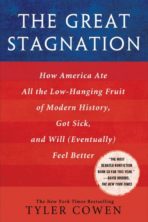
FAIRFAX, Va.—Tyler Cowen says he’s a “small-l libertarian,” but as the prolific George Mason University economics professor talks about jump-starting the economy, it’s clear his ideology isn’t easy to pigeonhole. Cowen says he believes government can spur innovation, but he’s skeptical of regulations and would slash 80 percent of them. In his 2011 book, The Great Stagnation: How America Ate All the Low-Hanging Fruit of Modern History, Got Sick, and Will (Eventually) Feel Better, he argues that we can fix things. The United States, he says, hasn’t lost its greatness.

Cowen, 50, earned a Ph.D. in economics at Harvard but has further-flung interests. After watching the legendary Spassky–Fischer chess match in 1972, the 10-year-old Cowen started playing the game and, five years later, became the youngest state champion in New Jersey history. He gave up chess for economics. “More interesting,” he says. “And it pays better.”

His curiosity is eclectic. His most recent book, An Economist Gets Lunch: New Rules for Everyday Foodies,explores the food marketplace, which has interested him since age 20, when he first lived abroad in Germany.

“Food is about innovation, small business and big business, entrepreneurship. How do you judge quality? Globalization. Key themes for the world.”

Edited excerpts from an interview follow.

How big an economic fix are we in?

COWEN: It depends on relative to what. We’re still one of the richest countries in the world. A lot of the nonmaterial aspects of our life have gotten a lot better, including social tolerance. So it’s hardly dystopia. But it is still the case we’re planning and spending as if we’ll grow 2 to 3 percent [annually], and we might just grow 1½ percent. That is a disaster. We are not adjusting our expectations to the reality. That said, I do think we will get out of the great stagnation. A lot of the stuff that will get us out of it, we’ve already done. 

Such as?

COWEN: The Internet. The Internet is still [a] somewhat immature technology, and you’ll see education, health care, and retail all fundamentally restructured for the better through the Internet. The Internet and smart machines, software, artificial intelligence—that conjunction of concepts is getting better rapidly. 

Can we return to economic greatness?

COWEN: We have never left greatness. In some ways, you could argue we are the only great country in the world—though Canada and Australia have good claims. In absolute terms, this country has never been better. It’s just the rate of economic improvement has slowed.

Does government have a role in spurring innovation?

COWEN: If you turn on a TV show from, say, the early 1970s, it is remarkable how much life looks familiar. You could take the people from that show and put them [here and now]. Except for computer Internet stuff, they could operate everything. That suggests progress has been slower than [since] earlier in the 20th century. But Internet, computers, artificial intelligence, smartphones—all that has been phenomenal. The government should fund science much, much more—basic research. 

Must we change our expectations of what government will do for people?

COWEN: In terms of spending and borrowing, our expectations have been out of whack with reality since the end of the Clinton administration. Now, these forthcoming technological breakthroughs will help, but we shouldn’t always assume they will translate into tax revenue. You can see a lot of great things coming and still worry about the budget. Take the music sector, which for listeners is better now than it ever has been by a lot. But the revenue in that sector has kind of collapsed. Journalism, too: A lot of stuff is great for readers, not good for revenue. It’s because of technology. We need to be very careful about equating progress with more revenue. For now, this connection between revenue and well-being is a much bigger disconnect than in the past. I sometimes say I am a “happiness optimist” but a “revenue pessimist.”        

THE KOREA TIMES: KT Plans to Expand Fixed-Line Investment

This article originally appeared in The Korea Times

KT said Thursday that it will expand investment on its fixed-line network to realize an efficient network infrastructure.

The firm’s business plan was revealed during its 17th IT CEO Forum under the theme “The Great Stagnation & Korea’s Transition” at the Renaissance Hotel in Gangnam, Seoul,

As the market wants access to the best network due to the widening use of long-term evolution (LTE), KT plans to save on costs and increase quality competitiveness by strengthening its “Fiber to the Home” fixed-line project for seamless connections everywhere by installing more local area networks (LAN) and upgrading LTE download speeds.

The mobile operator’s ultimate expansion goal is to lessen data traffic and expand its wired and wireless product portfolios.

KT is the largest fixed-line operator in Korea and is planning to use that advantage to assist its growing mobile business, the second-largest in the country, according to industry officials.

“No one can deny that KT is the largest and most powerful company among competitors when it comes to fast-speed LAN and fixed-line services. These projects can support its growing LTE business,” said one official.

The three domestic mobile carriers, KT, SK Telecom and LG Uplus have chosen different strategies to mark their respective services. SK Telecom offers free content downloads, while LG has opened up a cloud-based game platform.

The plan falls in line with George Mason University professor Tyler Cowen’s forum lecture on how the Korean economy will pull through the global recession using its growing power in Internet and cultural content businesses. Cowen was chosen as one of the most influential economists of the past decade by English weekly the Economist.

The professor met with KT Chairman Lee Suk-chae at the forum and discussed the future vision of the Korean economy and business philosophies.

According to KT, they pointed out some structural problems of the domestic economy and proposed solutions to bolster job creation in addition to finding a new business paradigm that will propel the information technology industry to become a new growth engine.

Since the completion of its nationwide LTE network earlier this year, the mobile operator has repeatedly stated that it plans to build other network equipment such as fixed-line telecommunications and WiFi to facilitate wireless connections. “We want to ensure that consumers from home to work or any other place are assured a stable connection,” said a KT executive.

“KT’s upgrade of its backbone network can impact not only its domestic telecom equipment businesses but the global competitiveness of domestic IT businesses,” said Kim Sung-man, head of KT’s network division. “We plan to cooperate with domestic manufacturers that have the technology and quality that is up to the global standard.”

Cowen also acknowledged in his speech that the proliferation of Korea’s creative industry offers significant gains to the domestic economy.

Around 300 executives from domestic information technology firms including 50 from startups attended the forum. The KT chairman also met Ofcom CEO Ed Richards Thursday on the sidelines of the conference, to discuss the future direction of telecom regulations. The two talked of the rising role of regulators as networks become increasingly important in the current era of smart devices.

“Though network-based businesses are growing rapidly, the value of telecommunications companies is declining,” said Lee. “Data traffic and revenue are disproportionate, which is weakening incentives to invest in networks.” Richards said, “The role of the regulator is becoming more and more important for the telecommunications market to develop continuously. Regulations should head towards the direction in which the interest of companies and consumers do not collide.”

THE WASHINGTON POST: Professors Promote Their Own MOOCs

This article originally appeared in The Washington Post

 What if two professors at a university launched their own university? Would the first university cheer them on?  Surprisingly, it might.

At least that is the case with George Mason University, George Mason economists Tyler Cowen and Alex Tabarrok and the free online education platform they have launched called Marginal Revolution University.It’s another twist in the high-speed development of massive open online courses: Entrepreneurial professors are creating and promoting their own MOOCs.

The MOOC movement is emerging as a disruptive force in higher education, as The Post reported last week. Universities everywhere are pondering how to react and whether the rush to open courses up to the world, free of charge, will threaten the institutions in the long run.

But many professors aren’t waiting. Some are posting courses — free and for charge — in an online portal called Udemy.

Cowen and Tabarrok have created a free-content Web site, MRUniversity.com, that will host several MOOCs. One might argue that MRU is not exactly a university because it is not accredited and it does not award degrees of any kind. But these days, even the definition of a university seems up for grabs.

The idea for a MOOC platform, Tabarrok said, sprung from a blog called Marginal Revolution that the two economists have authored for years.

“A big part of what Tyler and I like to do is communicate to the public,” Tabarrok said. “We think economics is important. It can save lives. It can make the world a better place. Literally the lives of billions of people hang on better economic policy. We want to make the lessons of economics available to as large an audience as possible.”

The first course from Cowen and Tabarrok, called development economics, drew more than 3,500 student registrations in its first week in October, Cowen said. Many are from India: New Delhi and Bangalore ranked among the top 10 cities of origin for visitors to the course.

The course covers geography and development; food and agricultural productivity; water economics and other topics. Videos are short and sweet, averaging about five minutes each. Cowen said they are designed to be easily viewed on mobile devices.

More courses are coming in early 2013, Cowen said, on the euro zone, Mexico, the economics of media and other topics.

None of which means that Cowen and Tabarrok are aiming to ditch their day jobs at GMU. They love being professors, hanging out on campus, talking with students.

“MRU will continue to grow,” Cowen said. “It’s not either/or. I enjoy the face-to-face. I don’t want to give that up under any circumstances.”

So what are the economics of this MOOC platform? Tabarrok said MRU is simply a Web platform they created. It is neither a for-profit company nor a nonprofit organization. It has no venture capital. It is getting behind-the-scenes support from one technical expert at the Mercatus Center at George Mason, a research center that Cowen leads, dedicated to the study of markets.

The center and George Mason are listed as supporters on the MRU Web site. But GMU has provided no direct funding.

Angel Cabrera, president of GMU, said he doesn’t feel threatened in the least by MRU.

Cabrera said the role of the university — in this case, GMU — is under constant discussion as MOOCs flourish. He envisions a university with numerous faculty entrepreneurs pushing online projects. He is content to be a cheerleader for experimentation.

“It makes me think,” Cabrera said, “how do I integrate the MOOC? Not how do I defend from it.”

THE NEW YORK TIMES: That Blurry Line Between Makers and Takers

This article originally appeared in The New York Times

MITT ROMNEY has apologized for his depiction of 47 percent of America as wealth takers rather than wealth makers. But his blunder touched inadvertently on some discomforting truths about the importance of politics in income distribution in the United States. 

If Mr. Romney’s points were to be reformulated in a more defensible direction, the outline might look something like this:

OF MAKING AND TAKING The correct distinction is not “makers versus takers.” The problem is that taking, rather than making wealth, appears to be growing in relative influence.

Most of us are actually both makers and takers. Consider farmers who produce food and favor agricultural subsidies. The question is whether the role of wealth maker has more influence over our politics, at any given time, than does the taker role. Is public policy being adjudicated on grounds of ethics and efficiency, or is the real story about lobbying and the relative power of different interest groups?

It isn’t easy to measure whether politics is less public-spirited these days, and we should resist the tendency to idealize the past. Still, job creation, median income and other measures of economic well-being have done poorly since the late 1990s. That suggests that America isn’t paying enough attention to creating wealth and increasing general prosperity.

FOLLOW THE MONEY Seven of the 10 most affluent counties in the nation are near Washington, D.C. That means a growing number of educated people are making a very good living advising, lobbying and otherwise influencing the federal government. This is a talent drain. It’s far from obvious that we are getting better policy as a result, and true wealth creation has not kept pace.

As Matthew Yglesias, a columnist for the online magazine Slate, has pointed out, there is also a subtler point about those wealthy Virginia and Maryland counties. They have high per capita incomes, not only because they attract educated, government-oriented professionals, but also because their zoning and building codes limit the supply of low-cost housing. That’s a significant government intervention that hurts lower-income people, who must pay more. Privilege-seeking through government is often most pernicious when it has a tidy front and a well-manicured green lawn.

UNEQUAL INFLUENCE Politics based on lobbying stacks the deck against lower-income groups, who are often outmaneuvered. For instance, one of the biggest problems faced by the poor today is inadequate K-12 education. They need improved public schools, more school choice, or some mix of both. Over time, such improvements would help deal with many other social and economic issues, including global competitiveness, domestic unemployment, public health and the budget deficit, because quality education has many beneficial effects.

Instead, the current system of transfers offers to the poor various sops in place of more effective reforms. Fundamental improvements to education would involve more challenging changes to residential zoning, teacher unions and certification systems, and might also take some educational finance and control out of the hands of local municipalities. It is no surprise that well-off families want to keep a system that has done very well by them, and that the poor often lose political battles over education.

EVERYONE FEELS ENTITLED People tend to think that they have justice on their side, whether it comes to making or taking.

For example, millions of homeowners have spent hundreds of thousands of dollars on the premise that the tax deduction for mortgages will be continued. If they support a continuation of that deduction they hardly feel like brigands, even though a bipartisan consensus of economists doubts the efficiency of this tax break.

As years and decades pass, recipients of this deduction and other benefits start to see them as deeply and richly deserved. Furthermore, almost all of us reap one or more of these benefits, so few individuals are consistently opposed to all government transfers.

It becomes difficult for a politician to articulate exactly what is wrong with this arrangement when the audience itself is in on the game and perhaps does not want to hear about its own takings.

A HISTORICAL PERSPECTIVE The Founding Fathers were extremely worried about the threat to society posed by corruption and privilege-seeking.

Drawing on examples going back to antiquity, they understood how unmitigated wealth-taking could create a negative and cumulatively self-reinforcing political dynamic. They also understood that the Constitution — or any constitution — would be an extremely imperfect remedy for this problem.

It is therefore correct to reject Mr. Romney’s depiction as off-base and misleading. Yet the fact that he didn’t present the truth is an indication that the problem is actually worse than many of us realize.

FREAKONOMICS: You Eat What You Are

“Americans are in the midst of a food paradox: we have access to more and better and cheaper food than ever before but at the same time, we are surrounded by junk food and a rise in obesity and heart disease. In this hour-long episode of Freakonomics Radio, host Stephen Dubner talks about our massive but balky food network with economist Tyler Cowen, who argues that agribusiness and commercialization are not nearly the villains that your foodie friends might have you think.”

FOREIGN POLICY: Cheapskates, Pessimists, & Food Trucks

This article originally appeared in Foreign Policy

In a recession, most economic sectors face hard times. Economists call this phenomenon “comovement,” and it is considered one of the most fundamental features of business cycles. Nonetheless, there are exceptions to most general principles, including this one. There are, in fact, many winners — not one — from the great crash of 2008, sectors that have shown signs of prospering in tough economic times and, more importantly, have shown signs of prospering because we have been in some tough times. If there is one strand that holds these disparate entities together, it is that all understood the zeitgeist of the downturn and knew how to profit from it. Consider the following:

L’Oréal, one of the world’s major cosmetic manufacturers, enjoyed robust sales even in 2008. A study recently published in the Journal of Personality and Social Psychology suggests that women buy more lipstick in tough economic times to make themselves more attractive to men.

In Greece, as the eurocrisis has progressed, booksellers report robust demand for downers, according to the New York Times – particularly the works of German philosopher Arthur Schopenhauer, a thinker renowned for his pessimistic attitude toward life.

According to consumer research groups, diaper sales slow in difficult times, but it seems demand for diaper rash ointment goes up. The reason? Families are either changing diapers less frequently or using lower-quality diapers, thus necessitating the ointment.

Had a Korean taco lately? If food carts are increasingly your workday lunch destination, you’re not alone. This $1 billion industry has grown 8.4 percent annually in the United States since the recession, according to market researcher IbisWorld – if only because they are cheaper than typical restaurant meals.

In 2009, stores selling religious goods did a brisk business in St. Joseph statues, according to theNew York Times. It is reputed that burying such a statue on your property helps you sell your home.

It’s often suggested that, in the long run, the American economy will slow down as the U.S. population ages. But this won’t be bad for all businesses. Funeral homes, anyone?

HUFFINGTON POST: MRUniversity Aims To Bring Economics Education To The Masses

This article originally appeared in Huffington Post

Two George Mason University economics professors are teaching on a new campus: in the cloud.

Tyler Cowen and Alex Tabarrok have launched MRUniversity, named after their blog MarginalRevolution.com, where they’ll enter the booming world of free online education alongside projects like Courseraand companies such as Udacity and edX. But Cowen and Tabarrok plan to do things a little differently. For one, they want other people to contribute their knowledge to the curriculum, much like they would on Wikipedia.

“[People] don’t have to pay $50,000 a year to Harvard,” Cowen said, “you can go online and get something for free.”

Setup costs were minimal for the two professors: They make course videos at home on an iPad with a $4 app called “Explain Everything,” then simply upload them to YouTube. They also had some help building the MRUniversity website.

The first course in development economics will “provide the equivalent of a 45-hour course in a series of narrated videos broken into short segments (most no longer than 5 minutes) that can be taken as a complete syllabus or in separate lessons,” according to the MRUinversity website. Cowen said a MRUniversity student won’t see the professors’ faces online, instead they’ll see “something like a blackboard.” There will also be quizzes and user-submitted content.

Over time, the hope is to have guest lecturers, so that Cowen and Tabarrok aren’t leading every video. They also want users to submit multiple types of content, including questions and answers, documents, PowerPoint presentations, and their own instructional videos.

They chose to start with development economics because they hope to provide access to education on the subject to people living in developing countries via the Internet.

“We want to see where it goes and modify accordingly,” Cowen said. “The end goal is to have created a site and a resource bank where people go for an economic education.”

But according to Bryan Caplan, another professor of economics at George Mason, Cowen and Tabarrok could potentially make a pretty pennywhile doing some public good.

“Even if online education tops out at 1% of the higher education market, and MRUniversity captures 1% of that 1%, they’ll be rich,” Caplan wrote in a blog post. “And it wouldn’t surprise me if they can do better in less-developed countries, where conformity norms don’t work so heavily against them. Even if MRUniversity never makes a dime, moreover, it will supply the public good of economic education that the world so sorely needs.”

Either way, there’s no shortage of appetite for free online courses: Some 1.5 million students have enrolled in classes offered by Coursera since it launched earlier this year, according to NPR.

This effort by the two professors brings George Mason into a rapidly growing field of online education. Notable institutions, including Stanford, Caltech, Oxford, Princeton, the University of Virginia, Emory, the University of California, MIT, the University of Pennsylvania and others have announced some sort of involvement with massive open online courses — or MOOCs.

Cowen said the Internet has changed so many aspects of our lives, so “Why should education stay behind?

“Education is changing rapidly and we want to go to our graves feeling we were on the right side of history, so-to-speak,” he said.